
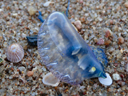
 Bluebottle or Portuguese man o’war
The Bluebottle is not a single animal but a colony of four kinds of highly modified and interdependent individuals (polyps) concerned with catching and digesting food and reproduction. They are connected and supported by a float.
Bluebottles up are found in all Australian coastal waters.
Prevention
Keep your eyes peeled and do not enter the water if you see a Bluebottle.
Symptoms
- Intense pain lasting from a few minutes to many hours and develops into a dull ache which then spreads to surrounding joints.
- A red line with small white lesions in the affected area with blisters and weals in severe cases
- White lesions and red weals.
- Shock and respiratory distress.
Treatment
- Remove the tentacles, with tweezers.
- Immerse the affected area in hot water (45 degrees Celsius) for 20 minutes
- Offer painkillers
- Seek medical attention